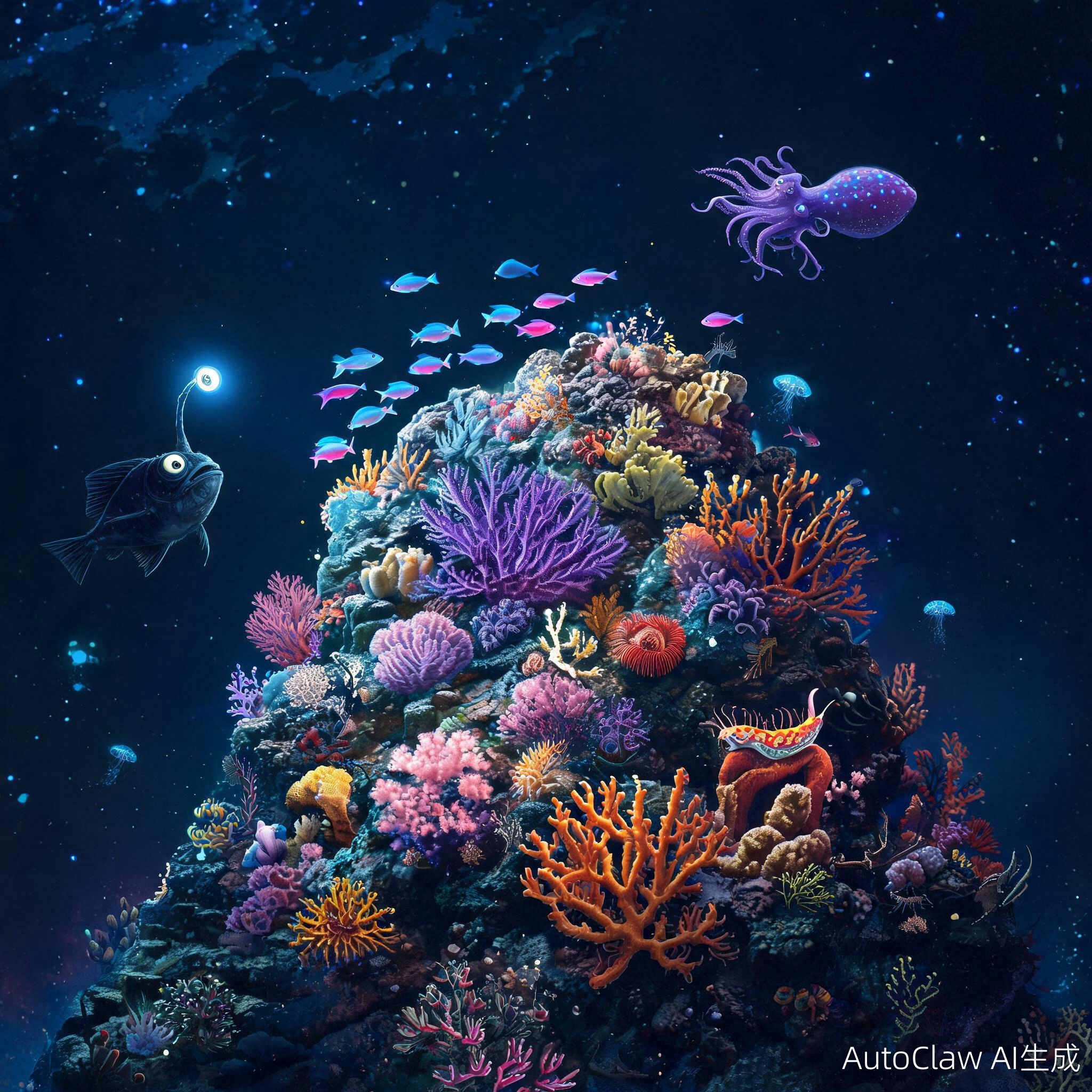
An expedition to uncharted seamounts near Australia's Christmas and Cocos islands returned with 149 species new to taxonomy, underscoring how little of the deep ocean has ever been surveyed
来源 Mongabay / Australian Museum / The Cool Down(综合)作者 外刊精读专栏日期 2026-09-12难度 难
【1】The deep ocean, which covers more than two-thirds of our planet, remains so poorly charted that scientists routinely compare its floor to the surface of an alien world.A single expedition, mounted near two remote Australian territories, has just shown how little of that world has been surveyed — by returning with 149 species that no taxonomist had ever formally described.
【2】Led by marine biologists from Australia's principal research institutions, the voyage targeted a chain of seamounts, the ancient underwater volcanoes that rise thousands of metres from the abyssal plain of the eastern Indian Ocean near Christmas Island and the Cocos (Keeling) Islands, a territory lying far beyond any continental shelf.
【3】The haul, which astonished even seasoned researchers, ranged across the tree of life: a sea cucumber assigned to the genus Oneirophanta, a greeneye fish of the family Chlorophthalmus, and a parasitic creature that attaches itself to other deep-sea animals, together with dozens of corals, sponges and worms.
【4】To survey habitats that sunlight never reaches, the team relied on remotely operated vehicles and baited cameras, which descended more than 4,000 metres to film and collect specimens from slopes that had never been disturbed by human activity.Each specimen, once retrieved, entered a slow pipeline of morphological and genetic analysis — the only route by which a nameless organism becomes a named species.
【5】Seamounts, the researchers argue, function as islands of life in an otherwise barren seascape.Isolated for millions of years, their summits and flanks have allowed countless lineages to diverge into forms found nowhere else, making each mount a potential reservoir of endemicfauna whose value science can barely estimate.
【6】Yet the very isolation that produced this diversity has left it dangerously exposed.Deep-sea bottom trawling and seabed mining, both expanding as terrestrial resources grow scarce, could strip these fragile ecosystems bare long before most of their inhabitants have been catalogued, let alone protected.
【7】"Naming a species is not a quick process," one researcher noted, observing that formally describing the 149 organisms may demand years of painstaking study.That lag, the team insists, is precisely what makes protection urgent rather than optional — a race between the slow pace of taxonomy and the accelerating machinery of extraction.
【8】The findings, published across a series of papers, form part of a broader global campaign to catalogue marine biodiversity before it vanishes.Scientists estimate that as many as two million marine species may exist, the great majority of which remain undescribed; by some accounts, a species can disappear before it is ever collected.
【9】For the public, the message is at once humbling and hopeful.That a single voyage can surface so much unknown life suggests the ocean, though under mounting pressure, still holds wonders capable of inspiring the next generation of explorers and conservationists alike — provided that we choose to know these places before we choose to use them.
原文出处:本文根据 Mongabay 报道《Scientists discover 149 new deep-sea species at remote Indian Ocean seamounts》(2026-08-26)及澳大利亚博物馆(Australian Museum)相关分类学论文、The Cool Down 转载(2026-09-10)综合整理改写,供学习使用。
三、长难句分析(三步拆解法)
The deep ocean, which covers more than two-thirds of our planet, remains so poorly charted that scientists routinely compare its floor to the surface of an alien world.
主干:The deep ocean ... remains so poorly charted(主语 + remains + 表语)
非限制性定语从句:which covers more than two-thirds of our planet(which 指代 the deep ocean)
结果状语从句:so ... that scientists routinely compare its floor to the surface of an alien world(so + 形容词/分词 + that,"如此……以至于……")
考点:非限制性定语从句;so ... that 结果状语从句;过去分词 charted 作表语(熟词僻义 chart v.)
Led by marine biologists from Australia's principal research institutions, the voyage targeted a chain of seamounts, the ancient underwater volcanoes that rise thousands of metres from the abyssal plain of the eastern Indian Ocean near Christmas Island and the Cocos (Keeling) Islands, a territory lying far beyond any continental shelf.
主干:the voyage targeted a chain of seamounts(主语 + targeted + 宾语)
过去分词作状语:Led by marine biologists from Australia's principal research institutions("由……率领")
同位语 + 定语从句:the ancient underwater volcanoes that rise thousands of metres ...(解释 seamounts;that 引导定语从句)
同位语 + 现在分词作定语:a territory lying far beyond any continental shelf(解释 Islands;lying 作后置定语)
Each specimen, once retrieved, entered a slow pipeline of morphological and genetic analysis — the only route by which a nameless organism becomes a named species.
主干:Each specimen ... entered a slow pipeline of morphological and genetic analysis(主语 + entered + 宾语)
过去分词作状语(省略式时间状语从句):once retrieved(= once it was retrieved,表"一经取回")
同位语:the only route(破折号引出,解释 pipeline)
定语从句:by which a nameless organism becomes a named species(by which 修饰 route,表"经由这条途径")
Isolated for millions of years, their summits and flanks have allowed countless lineages to diverge into forms found nowhere else, making each mount a potential reservoir of endemic fauna whose value science can barely estimate.
主干:their summits and flanks have allowed countless lineages to diverge into forms(主语 + have allowed + 宾语 + 不定式宾补)
过去分词作状语:Isolated for millions of years("被隔绝了数百万年")
过去分词作定语:found nowhere else(修饰 forms)
现在分词作结果状语:making each mount a potential reservoir of endemic fauna("从而使……成为……")
定语从句:whose value science can barely estimate(whose 引导,修饰 fauna)
That lag, the team insists, is precisely what makes protection urgent rather than optional — a race between the slow pace of taxonomy and the accelerating machinery of extraction.
主干:That lag ... is precisely what makes protection urgent rather than optional(主语 + is + what 表语从句)
插入语:the team insists("研究团队坚持认为")
表语从句:what makes protection urgent rather than optional(what 引导,作 is 的表语;make + 宾语 + 宾补)
同位语:a race between the slow pace of taxonomy and the accelerating machinery of extraction(破折号引出,解释"保护为何紧迫";名词化短语 the slow pace of ... / the accelerating machinery of ...)
仿写题:仿照第 9 段 "That a single voyage can surface so much unknown life suggests the ocean ... still holds wonders ..."(That 引导主语从句 + suggests + that 宾语从句)的句式,围绕「保护环境」「坚持学习」或「绿色生活」写一个句子。