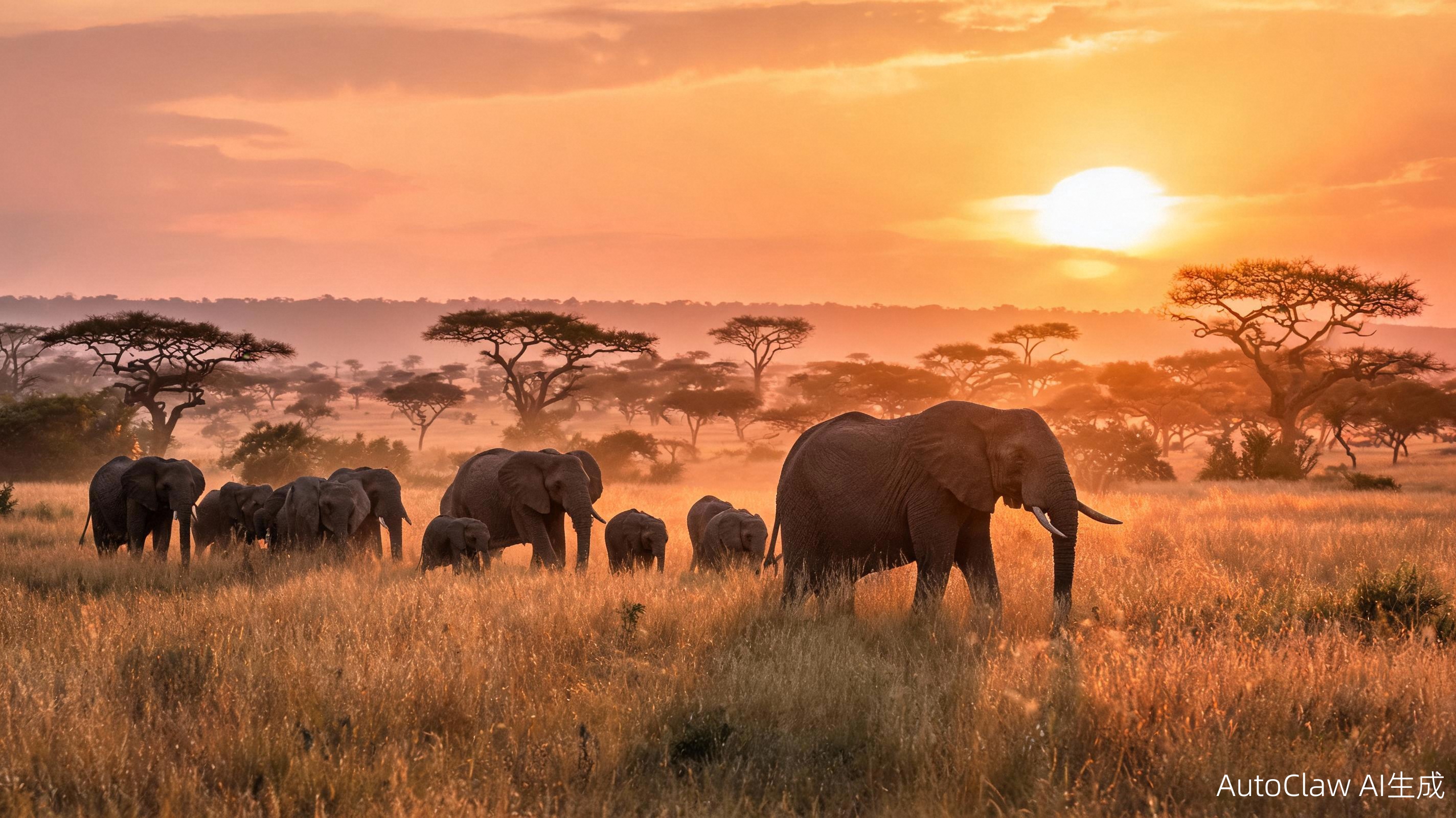
A machine-learning analysis of hundreds of elephant calls suggests that wild African elephants address one another with individually specific rumbles — the first non-human animal known to use name-like calls that are not mere imitation
来源 Nature Ecology & Evolution / Colorado State University / Save the Elephants(综合)作者 外刊精读专栏日期 2026-09-14难度 难
【1】For centuries, humans have assumed that the ability to address one another by name is uniquely ours.A new study of wild African savannah elephants suggests otherwise: these animals appear to address each other with individually specific rumbles — the first non-human creature known to use name-like calls that are not mere imitation.
【2】Led by researchers at Colorado State University and published in the journal Nature Ecology & Evolution, the study drew on 469 recorded rumbles collected from two populations in Kenya over roughly 36 years.The team fed the acoustic features of each call into a machine-learning model and asked it to predict which specific elephant a given call was directed toward.
【3】To rule out the possibility that receivers were simply reacting to the caller's voice, the researchers also conducted playback experiments with 17 elephants.When they heard a call originally addressed to them, the animals approached the loudspeaker more quickly and produced more vocalizations in response, a pattern that vanished when the same call was played to a different elephant.
【4】The model, by contrast, proved a surprisingly able listener.Guided by acoustic cues alone, it correctly identified the intended receiver in more than a quarter of trials — a rate far above chance, and one that held even when the calls came from unfamiliar voices, suggesting that the "names" reside in the call itself rather than in the caller's identity.
【5】What makes the finding striking is its departure from the animal kingdom's better-known examples.Dolphins and parrots, for instance, produce signature whistles or calls that are acquired by imitating other individuals — a form of "calling" that copies rather than labels.The elephants, by contrast, appear to use arbitrary, non-imitative sounds — a step conceptually closer to the way human names work.
【6】Such labels, the authors argue, make sense for a species whose society is built on long-distance communication and dense kinship networks.Elephants frequently separate and reunite across vast savannahs, and a mother, or a matriarch guiding her herd, may need to single out one distinct individual among dozens without visual contact — a demand that imitation alone cannot meet.
【7】To be sure, the researchers are careful not to overstate the case.Whether these calls carry the full semantic weight of human names remains unknown, and the team could not prove that elephants understand a call as referring to a specific individual in the way that we do."This is an exciting step, but many questions remain," one author noted, observing that the study raises as many questions as it answers.
【8】The discovery nonetheless reshapes how scientists think about the evolution of language.If a non-primate mammal, whose last common ancestor with humans lived tens of millions of years ago, can evolve name-like communication, then the building blocks of language may be far older, and far more widespread, than once believed.
【9】For conservationists, the finding carries a quieter lesson.Each of these elephants — each named, recognized, and addressed within its own society — is an individual, not a number; and the more we learn about the richness of their inner lives, the harder it becomes to treat them, or their shrinking habitats, as expendable.
原文出处:本文根据《自然·生态与进化》(Nature Ecology & Evolution,2024 年 6 月)刊发、由科罗拉多州立大学(Colorado State University)与"拯救大象"组织(Save the Elephants)联合开展的非洲象"个体命名"研究,及相关公开报道综合整理编写,供学习使用。
三、长难句分析(三步拆解法)
Led by researchers at Colorado State University and published in the journal Nature Ecology & Evolution, the study drew on 469 recorded rumbles collected from two populations in Kenya over roughly 36 years.
主干:the study drew on 469 recorded rumbles(主语 + drew on + 宾语)
过去分词短语作状语:Led by researchers … and published in the journal …(并列过去分词,说明研究的"出身")
后置定语(过去分词短语):collected from two populations in Kenya over roughly 36 years(修饰 rumbles)
When they heard a call originally addressed to them, the animals approached the loudspeaker more quickly and produced more vocalizations in response, a pattern that vanished when the same call was played to a different elephant.
主干:the animals approached the loudspeaker … and produced more vocalizations(并列谓语)
时间状语从句:When they heard a call originally addressed to them(originally addressed to them 作 call 的后置定语)
同位语 + 定语从句:a pattern that vanished …(a pattern 概括前面整句内容;that 引导定语从句,其中又含 when 时间状语从句)
Guided by acoustic cues alone, it correctly identified the intended receiver in more than a quarter of trials — a rate far above chance, and one that held even when the calls came from unfamiliar voices, suggesting that the "names" reside in the call itself rather than in the caller's identity.
主干:it correctly identified the intended receiver(主语 + identified + 宾语)
过去分词短语作状语:Guided by acoustic cues alone("仅凭声学线索")
同位语 + 定语从句:a rate far above chance, and one that held even when …(one 指代 a rate;that 引导定语从句)
现在分词作结果状语:suggesting that the "names" reside in the call itself(suggesting 引出结论,that 宾语从句)
If a non-primate mammal, whose last common ancestor with humans lived tens of millions of years ago, can evolve name-like communication, then the building blocks of language may be far older, and far more widespread, than once believed.
主干:the building blocks of language may be far older, and far more widespread, than once believed(主句,系表结构)
条件状语从句:If a non-primate mammal … can evolve name-like communication
非限制性定语从句:whose last common ancestor with humans lived tens of millions of years ago(whose 引导,修饰 mammal)
考点:if 条件句;whose 非限制性定语从句;形容词比较级 older / more widespread;than once believed(省略)
Each of these elephants — each named, recognized, and addressed within its own society — is an individual, not a number; and the more we learn about the richness of their inner lives, the harder it becomes to treat them, or their shrinking habitats, as expendable.
主干(并列句):Each of these elephants … is an individual, not a number; and the harder it becomes to treat them … as expendable
插入语(同位说明):each named, recognized, and addressed within its own society(三个过去分词并列)
比较结构:the more we learn …, the harder it becomes …(the + 比较级,the + 比较级,"越……越……")