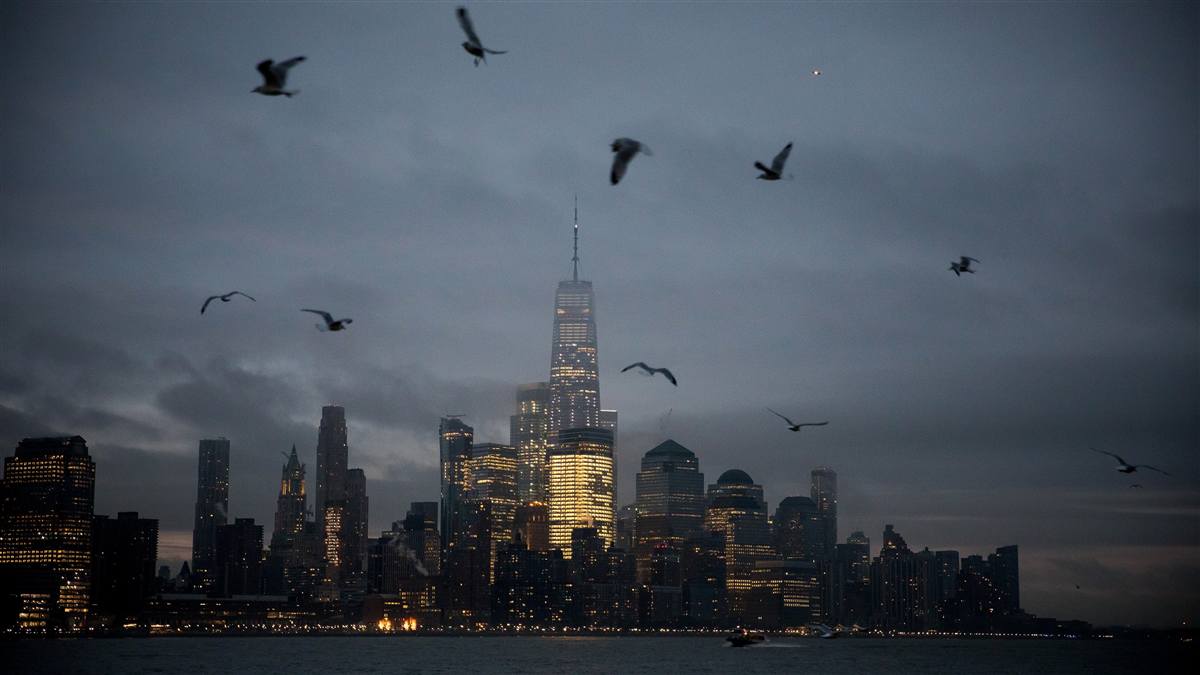
A radar-and-satellite study finds that artificial light is the strongest predictor of where migrating birds stop to rest — drawing them into bright but barren "ecological traps"
【1】For most of human history, the night sky was a reliable map — a vast, predictable dome of stars by which countless creatures steered their lives.That map is now being erased.Artificial light, spreading outward from cities, has turned the once-dark horizon into a glowing haze, with the consequences for animals that navigate by starlight only beginning to be understood.
【2】The scale of the problem has been made newly visible by a study published in the journal Nature Communications, which combined radar observations of migrating birds with satellite measurements of nighttime light across the United States.Tracking birds through the air, the researchers could at last ask a question that had long eluded scientists: when a weary migrant touches down for the night, what determines where it lands?
【3】The answer was as clear as it was troubling.Artificial light, the team found, was the single strongest predictor of where migrating birds chose to stop — stronger than temperature, stronger than vegetation or water.Where a city's glow burned brightest, birds gathered in numbers that bore little relation to the quality of the habitat below.
【4】This, the authors argue, is the signature of an "ecological trap." In a natural landscape, the cues an animal uses to judge a place are reliable guides to its true value.Artificial light decouples those cues from reality, luring birds into habitats that harbor little food or shelter — bright, yet dangerously barren.
【5】The mechanism reaches back to the deep past.Many nocturnal migrants steer by celestial cues, reading the stars and the moon as a compass — an instinct they cannot easily unlearn.A sky veiled in artificial glow can disorient a bird mid-flight, drawing it off its trajectory and onto a costly detour toward the very cities that produced the light.
【6】The costs are concrete.Studies document migrants circling illuminated towers until exhaustion, colliding with glass by the hundreds of millions each year, and falling prey to predators that have learned to hunt beneath the glow.Over time, the disruption may shift the timing of migration itself, with effects that ripple through entire ecosystems.
【7】The researchers are careful to acknowledge the limits of their work.Light is rarely the only stressor a migrant faces, and the pathways from a bright horizon to a bird's death remain, in many cases, conjectural.Yet the association, they note, is hard to dismiss, arriving just as the world's dark places are in steep decline.
【8】The hopeful corollary is that light pollution is, in principle, the easiest of environmental harms to reverse."Lights Out" campaigns, which ask cities to dim or extinguish unnecessary illumination during migration seasons, have already cut bird collisions, and shielded, downward-facing lighting can preserve human safety while restoring darkness overhead.
【9】For those of us who rarely look up at night, the finding is a quiet invitation.Darkness is not the absence of anything; it is a refuge in its own right, a habitat that billions of creatures depend on, and one we can begin to restore — not with a grand gesture, but by simply turning down the lights.
The scale of the problem has been made newly visible by a study published in the journal Nature Communications, which combined radar observations of migrating birds with satellite measurements of nighttime light across the United States.
主干:The scale of the problem has been made newly visible by a study(主语 + has been made + 宾补 + by 施动者,被动语态)
过去分词作后置定语:published in the journal Nature Communications(修饰 study)
非限制性定语从句:which combined radar observations of migrating birds with satellite measurements of nighttime light(which 指代 study;combined A with B 搭配;migrating birds 现在分词作定语)
考点:现在完成时被动语态;过去分词作后置定语;which 非限制性定语从句;combine A with B
A sky veiled in artificial glow can disorient a bird mid-flight, drawing it off its trajectory and onto a costly detour toward the very cities that produced the light.
主干:A sky ... can disorient a bird mid-flight(主语 + can disorient + 宾语 + 时间状语 mid-flight)
过去分词作后置定语:veiled in artificial glow(修饰 sky,"被人造光遮蔽的天空")
现在分词作结果状语:drawing it off its trajectory and onto a costly detour(drawing 表结果;off ... and onto ... 并列介词短语)
定语从句:that produced the light(修饰 cities)
考点:过去分词作后置定语;现在分词作结果状语;that 定语从句;the very + 名词 表强调
Studies document migrants circling illuminated towers until exhaustion, colliding with glass by the hundreds of millions each year, and falling prey to predators that have learned to hunt beneath the glow.
主干:Studies document migrants(主语 + document + 宾语)
三个并列现在分词作宾语补足语:circling illuminated towers until exhaustion / colliding with glass ... / falling prey to predators ...(描述 migrants 的三种状态)
过去分词作定语:illuminated towers("被照亮的塔楼")
定语从句:that have learned to hunt beneath the glow(修饰 predators)
考点:现在分词作宾语补足语;过去分词作定语;that 定语从句;by the hundreds of millions 表数量
Darkness is not the absence of anything; it is a refuge in its own right, a habitat that billions of creatures depend on, and one we can begin to restore — not with a grand gesture, but by simply turning down the lights.
主干(并列句):Darkness is not the absence of anything; it is a refuge ...(分号连接两个并列分句)
表语 1:not the absence of anything("不是什么都没有")
表语 2 + 同位语:a refuge ... a habitat that billions of creatures depend on, and one we can begin to restore(a habitat 与 one 为 refuge 的同位语)
定语从句:that billions of creatures depend on(修饰 habitat;depend on 的 on 提前);we can begin to restore(省略关系代词,修饰 one)
对比结构:not with a grand gesture, but by simply turning down the lights(not ... but ..."不是……而是……")
考点:分号并列;同位语;"介词 + which/that" 定语从句;not ... but ... 结构;动名词短语 turning down
仿写题:仿照第 9 段 "Darkness is not the absence of anything; it is a refuge in its own right, a habitat that billions of creatures depend on ..."(分号并列 + not ... but ... + 同位语)的句式,围绕「保护环境」「节约资源」或「坚持阅读」写一个句子。