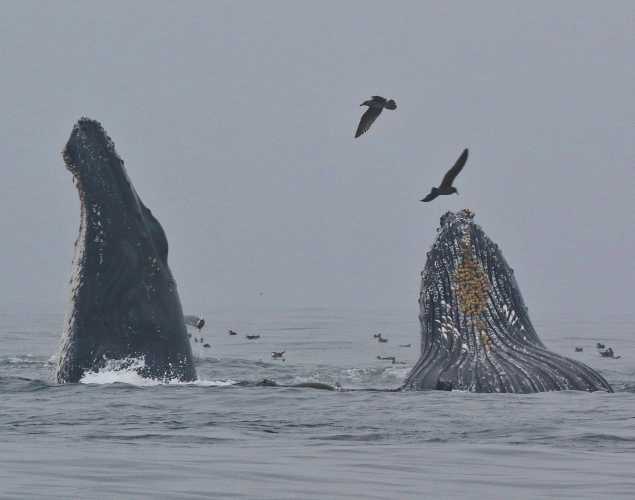
【1】The song of the humpback whale is among the most complex sounds in the animal kingdom, a series of moans, cries and rumbles that a singing male may repeat for hours on end.Yet for all its beauty, one question has long puzzled marine biologists: what, exactly, is a singing whale doing beneath the waves while it performs?
【2】A team of biologists at Syracuse University set out to answer that question with a tool that had never been applied in quite this way.Working off the island of Maui, they attached suction-cup tags, which record both sound and movement, to sixteen adult whales, capturing thousands of dives and the songs that accompanied them.
【3】The results, published in the journal Current Biology, revealed a remarkably tight correspondence between the structure of a whale's song and the stages of its dive.Specific song themes, the researchers found, are matched to specific phases of the dive cycle, as if each movement of the body were choreographed to a particular musical passage.
【4】As a whale descended, it sang one set of themes; as it turned and ascended toward the surface, it sang another.The deepest portions of a dive, in particular, were associated with the most elaborate segments of the song, suggesting that the animals were not merely singing at random but organising their repertoire around the rhythm of their own breath and motion.
【5】This link between sound and behaviour is more than a curiosity.Because singing whales are notoriously difficult to observe underwater, the discovery offers researchers a kind of acoustic window: by listening to which theme a whale is singing, they may be able to monitor where it is in a dive and how its body is moving, without ever seeing it.
【6】The finding also deepens our understanding of why whales sing at all.Humpback song is culturally transmitted — learned, modified and shared within populations — and its intricate structure is now shown to be inseparable from the physical act of diving, a feat that demands careful management of air and energy under crushing pressure.
【7】"The song is not just floating above the behaviour; it is woven into it," one of the researchers noted, adding that the correspondence could help scientists convey and track the physiological state of whales in places and at depths where visual tracking is impossible.
【8】The authors are careful to note the study's limits.The sample of sixteen whales came from a single breeding ground, and whether the same song-to-dive mapping holds for other populations, or for females and calves, remains an open question that will require far more listening.
【9】For those who study and love the ocean, the work carries a profoundimplication.It suggests that even the most familiar sounds of the sea still hold secrets, and that understanding them may be vital to protecting the elusive creatures that produce them — whales whose hidden lives we are only beginning to hear.
原文出处:本文根据雪城大学(Syracuse University)生物学系研究《How a Whale's Dive Shapes Its Song》(发表于 Current Biology,2026-08)及 Earth.com、Syracuse Today 相关报道(2026-08-31)综合整理改写,供学习使用。
三、长难句分析(三步拆解法)
The song of the humpback whale is among the most complex sounds in the animal kingdom, a series of moans, cries and rumbles that a singing male may repeat for hours on end.
主干:The song ... is among the most complex sounds(主语 + is + 表语)
后置定语:of the humpback whale 修饰 song;in the animal kingdom 修饰 sounds
同位语 + 定语从句:a series of moans, cries and rumbles that a singing male may repeat for hours on end(解释 the song;that 引导定语从句)
考点:among the + 最高级;同位语;that 定语从句;for hours on end 短语
Working off the island of Maui, they attached suction-cup tags, which record both sound and movement, to sixteen adult whales, capturing thousands of dives and the songs that accompanied them.
主干:they attached suction-cup tags ... to sixteen adult whales(主语 + attached A to B)
现在分词作状语:Working off the island of Maui("在毛伊岛附近工作")
非限制性定语从句:which record both sound and movement(which 指代 tags)
现在分词作结果状语:capturing thousands of dives and the songs that accompanied them(内含 that 定语从句修饰 songs)
Specific song themes, the researchers found, are matched to specific phases of the dive cycle, as if each movement of the body were choreographed to a particular musical passage.
主干:Specific song themes ... are matched to specific phases of the dive cycle(主语 + are matched to + 宾语)
插入语:the researchers found("研究者发现")
方式状语从句(虚拟语气):as if each movement of the body were choreographed to a particular musical passage(as if 后用 were,表"仿佛")
Because singing whales are notoriously difficult to observe underwater, the discovery offers researchers a kind of acoustic window: by listening to which theme a whale is singing, they may be able to monitor where it is in a dive and how its body is moving, without ever seeing it.
主干:the discovery offers researchers a kind of acoustic window(主语 + offers + 间接宾语 + 直接宾语)
原因状语从句:Because singing whales are notoriously difficult to observe underwater
同位语(冒号引出):by listening to which theme ... they may be able to monitor where ... and how ...(介词 + which 宾语从句;where/how 宾语从句并列)
Humpback song is culturally transmitted — learned, modified and shared within populations — and its intricate structure is now shown to be inseparable from the physical act of diving, a feat that demands careful management of air and energy under crushing pressure.
主干:Humpback song is culturally transmitted ... and its intricate structure is now shown to be inseparable from the physical act of diving(并列句)
插入语(过去分词并列):learned, modified and shared within populations(补充说明"文化传播")
同位语 + 定语从句:a feat that demands careful management of air and energy(解释 diving;that 定语从句)