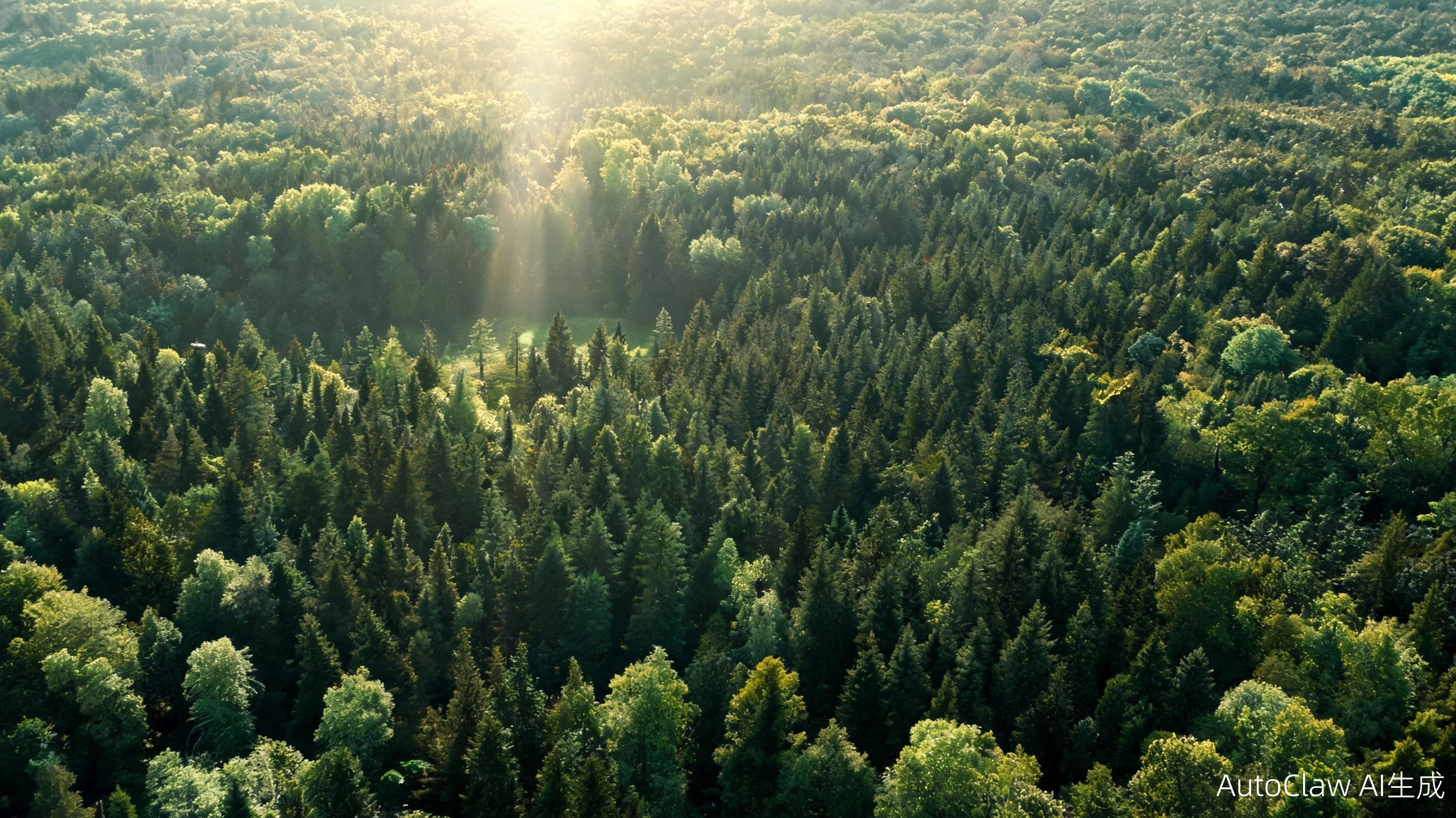
A study published in Nature Communications finds that forests rich in tree species resist and recover from compound heat-and-drought extremes better than simplified stands — evidence that biodiversity acts as insurance against climate breakdown
【1】Forests, long regarded as the planet's most dependable carbon storehouses, are being pushed to their limits by a climate that no longer behaves as it once did.Heat and drought, once occasional, now arrive together.The combination — what ecologists call "compound extremes" — is testing whether the world's woodlands can hold their ground.
【2】A study published in the journal Nature Communications set out to measure exactly that, drawing on data from forest plots spanning several continents, together with decades of satellite records.Led by an international team of researchers, the analysis compared how stands with different numbers of tree species responded when heat and drought struck at once.
【3】The authors focused on two separate qualities.Resistance is a forest's capacity to keep functioning while the stress is at its worst; recovery is the speed with which it bounces back afterwards.Together these two measures define what scientists call resilience, the ability of an ecosystem to absorb disturbance without collapsing.
【4】The results were strikingly consistent.Wherever tree diversity was high, forests not only resisted compound extremes more effectively but also recovered more quickly, a pattern that held across both temperate and boreal regions.In the authors' words, species richness appears to function as a form of "biological insurance," cushioning ecosystems against shocks no single species could withstand alone.
【5】The mechanism, the team suggests, lies in complementarity — the tendency of different species to occupy different niches.With roots reaching different depths and crowns intercepting light at different heights, a mixed forest uses water, light and nutrients more completely, and when one species suffers, others step into the breach, buffering the whole.
【6】The contrast with simplified stands was equally telling.Monocultures, however fast they grow, place all their bets on a single set of traits.A drought that overwhelms that one strategy can fell an entire plantation at once, whereas a diverse forest, spreading its risk, rarely fails all at once.
【7】The authors are careful to temper the claim.They acknowledge that the study is correlational rather than experimental, and that the insurance effect, though real, is modest in size.Its strength, they note, also varies with context.It dims in places where water scarcity is so severe that no amount of diversity can rescue a forest from collapse.
【8】"Planting a single fast-growing species may look efficient on paper," one of the lead researchers observed, "but a forest is not a crop.What we are learning is that diversity is not an ornament; it is the load-bearing structure of a woodland, and we ignore it at our peril."The practical message, she argued, is that reforestation should favour mixtures over monocultures.
【9】For a world scrambling to restore its forests, the implication is sobering yet hopeful.Trees alone will not stop climate change, and diversity alone cannot make a forest invulnerable.Yet choosing many species over one remains among the cheapest forms of protection available — insurance purchased not with money but with a commitment to letting forests be forests.
原文出处:本文根据《自然·通讯》(Nature Communications)刊发的研究《Biodiversity buffers forest ecosystems from compound climate extremes》(2026-09),及 The Conversation、preventionweb 相关科普报道(2026-09)综合整理改写,供学习使用。
三、长难句分析(三步拆解法)
Forests, long regarded as the planet's most dependable carbon storehouses, are being pushed to their limits by a climate that no longer behaves as it once did.
主干:Forests ... are being pushed to their limits(主语 + 进行时被动语态)
过去分词短语作后置定语:long regarded as the planet's most dependable carbon storehouses(修饰 Forests,表"长期被视为……")
定语从句:that no longer behaves as it once did(修饰 climate,内含 as 引导的方式状语从句)
考点:过去分词作后置定语;that 定语从句;现在进行时被动语态 be being done
译文:长期以来被视为地球上最可靠"碳仓库"的森林,正被一个不再像以往那样运作的气候逼向极限。
A study published in the journal Nature Communications set out to measure exactly that, drawing on data from forest plots spanning several continents, together with decades of satellite records.
主干:A study ... set out to measure exactly that(主语 + set out to do)
过去分词短语作后置定语:published in the journal Nature Communications(修饰 study)
现在分词短语作伴随状语:drawing on data from forest plots ...(内含现在分词短语 spanning several continents 作后置定语修饰 plots)
Wherever tree diversity was high, forests not only resisted compound extremes more effectively but also recovered more quickly, a pattern that held across both temperate and boreal regions.
主干:forests not only resisted compound extremes ... but also recovered more quickly(not only ... but also 并列谓语)
让步状语从句:Wherever tree diversity was high(wherever 引导,"无论何处……")
同位语 + 定语从句:a pattern that held across both temperate and boreal regions(a pattern 概括前面整个主句;that 定语从句)
考点:wherever 引导让步状语从句;not only ... but also;同位语 + that 定语从句
With roots reaching different depths and crowns intercepting light at different heights, a mixed forest uses water, light and nutrients more completely, and when one species suffers, others step into the breach, buffering the whole.
主干:a mixed forest uses water, light and nutrients more completely(主语 + uses + 宾语)
独立主格结构(with + n. + 现在分词):With roots reaching different depths and crowns intercepting light at different heights(表伴随状态)
仿写题:仿照第 4 段 "Wherever tree diversity was high, forests not only resisted ... but also recovered ..."(wherever 引导让步状语从句 + not only ... but also)的句式,围绕「坚持阅读」「低碳出行」写一个句子。