A twelve-year study of 149 ancient genomes from Gansu finds that wheat, barley, cattle and sheep crossed Eurasia into northwest China roughly 4,000 years ago — yet left no detectable trace of the western farmers who first domesticated them
来源 Cell(2026-09-03)/ 中国科学院古脊椎动物与古人类研究所作者 施涵、E. Andrew Bennett、陈国科、王辉、刘歆益、付巧妹等日期 2026-10-02难度 极难
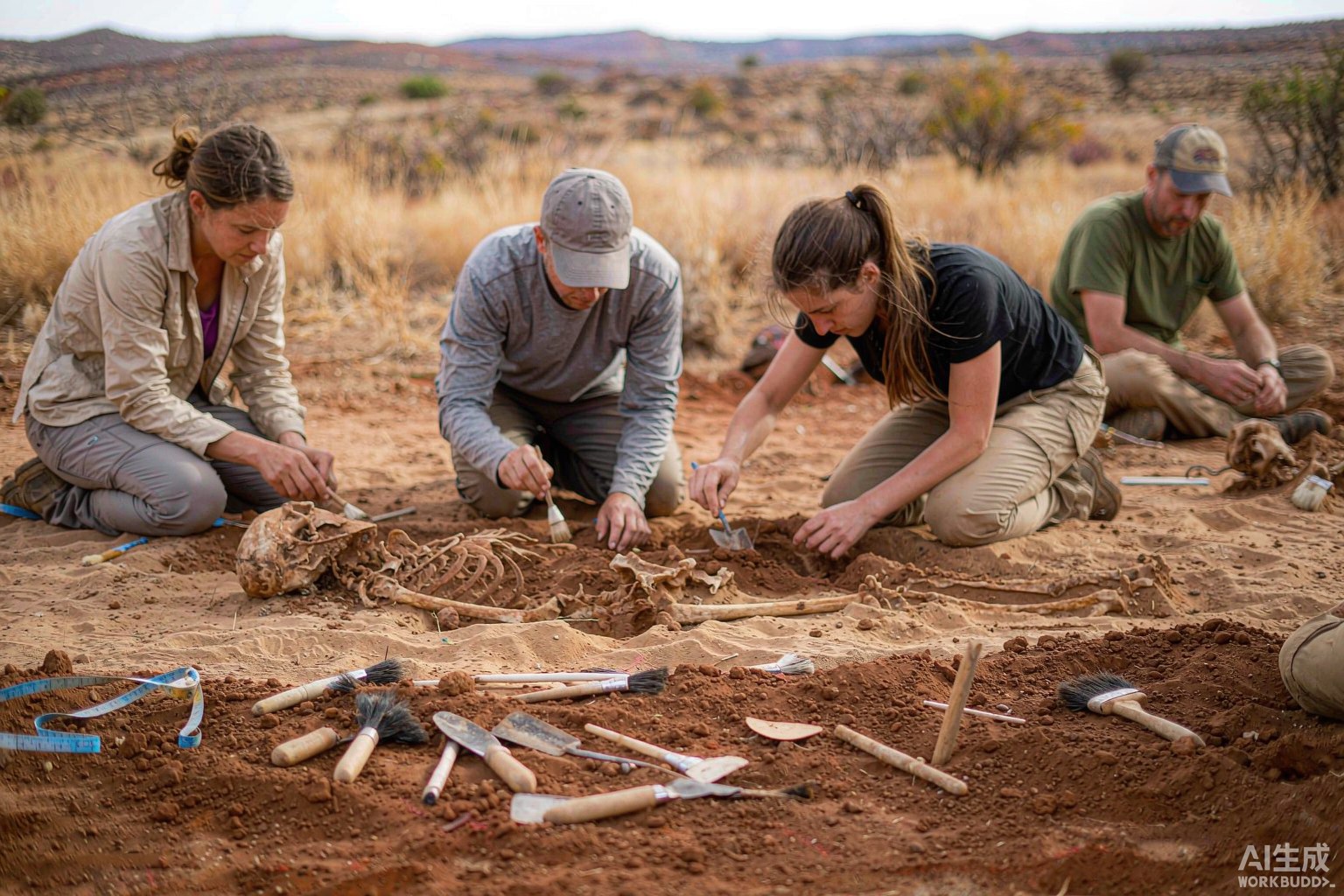
配图:考古队员在田野遗址中小心清理古代墓葬的人骨遗骸——古 DNA 正是从这类遗骸中提取、测序(图片来源:AI 生成配图,仅供教学使用)。
【1】Gansu, a narrow province in northwestern China, sits where three great landforms meet, making the region a crossroads of corridors along which people, ideas and goods once moved between East and West.By roughly 4,000 years ago, crops and livestock first domesticated in southwest Asia — wheat, barley, cattle, sheep — had begun to appear there, yet how they arrived remained deeply contested.
【2】A central debate in archaeology concerns whether such domesticates travelled with the people who bred them, or merely with their know-how.In Europe and Central Asia, the answer was long regarded as settled: farming spread alongside the farmers, and genomes still bear the imprint of those expansions thousands of years later, yet whether the same template applied to East Asia had never been tested with adequate data.
【3】Led by Fu Qiaomei of the Institute of Vertebrate Paleontology and Paleoanthropology, an international team spent twelve years extracting and sequencing ancient human genomes from eleven sites across Gansu.After quality filtering, the researchers obtained 149 individuals dating from roughly 4,700 to 3,000 years before present, ninety-five of them from the large Mogou cemetery, while nine of the eleven sites yielded western-derived crops or livestock, meaning the domesticates had demonstrably reached the region.
【4】The genetic results, published in the journal Cell, were striking in their consistency.Three independent methods — principal component analysis, ancestry modelling and D-statistics — placed every sampled individual within the range of East Asian variation, with no detectable ancestry from western or central Eurasia, and Fu observed that the region's ancient population remained chiefly a mixing of northern East Asian groups.
【5】That finding decouples the movement of crops from the movement of people.West Asian farming and metallurgy evidently crossed the continent, yet the farmers and herders who first developed them did not — at least not in numbers large enough to leave a genetic signature, so any account of trans-Eurasian food globalization must now explain how seeds and breeding stock travelled roughly 4,000 kilometres alone.
【6】The authors carefully limit the reach of what may be inferred from their data.Absence of evidence at the population level, they concede, is not proof that no individual of western Eurasian descent ever set foot in Gansu; what the data rule out is a demographic event large enough to register.They propose two candidate mechanisms — cultural diffusion along the Inner Asian Mountain Corridor, or transmission through intermediary groups on the Mongolian Steppe — while noting that direct support for either route remains thin.
【7】The study's social findings are, if anything, still more surprising.At Mogou, one of the largest excavated cemeteries in China, thousands of individuals were interred over centuries, yet detailed kinship analysis found no strong evidence that people buried together were biological relatives, and relatedness did not correlate with burial position.Males and females showed no significant difference in their genetic relationships, which is inconsistent with either strict patrilocal or matrilocal residence.
【8】Burial practice, the researchers suggest, was organised less around blood than around status: individuals whose genomes set them apart from the core community were more likely to be buried in archaeologically read as lower-status contexts.The authors raise the possibility that some were captives taken in small-scale conflict, yet no single factor — kinship, sex or date of death — seems to have determined who was laid beside whom.
【9】The work carries a wider lesson about assuming that pots, crops and genes must move together.Trade, curiosity and the sheer appetite of communities to adopt what works can carry techniques across continents without displacing the peoples who develop them.In Gansu, a society absorbed the products of a distant agricultural revolution while keeping its own genetic continuity, a reminder that cultural exchange is not always, or even usually, a story of replacement.
原文出处:本文根据《细胞》(Cell)2026 年 9 月 3 日在线发表论文《Genomics and social practices at Mogou and other Gansu sites during prehistoric trans-Eurasian exchange》(Shi, Bennett, Chen, Wang, Liu, Fu et al.)及中国科学院古脊椎动物与古人类研究所新闻稿综合整理改写,供学习使用。
三、长难句分析(三步拆解法)
For archaeologists, this geography has long made the region a crossroads of corridors along which people, ideas and goods once moved between East and West.
主干:this geography has long made the region a crossroads(主语 + made + 宾语 + 宾语补足语)
固定结构:make + 宾语 + 名词("使……成为……")
定语从句:along which people, ideas and goods once moved("介词 + which" 引导,修饰 corridors)
In Europe and Central Asia, the answer was long regarded as settled: farming spread alongside the farmers, and genomes still bear the imprint of those expansions thousands of years later.
主干:the answer was long regarded as settled(被动语态:be regarded as + 形容词)
冒号后同位说明:farming spread alongside the farmers, and genomes still bear the imprint…(用两个分句解释何为"settled")
并列句:farming spread … and genomes still bear …(两个主语平行)
Absence of evidence at the population level, they concede, is not proof that no individual of western Eurasian descent ever set foot in Gansu; what the data rule out is a demographic event large enough to register.
主干(前分句):Absence of evidence … is not proof(主语 + is not + 表语)
插入语:they concede("他们承认",插入主谓之间)
同位语从句:that no individual … ever set foot in Gansu(解释 proof 的具体内容)
主语从句:what the data rule out("数据所排除的(情况)",作第二分句主语)
后置定语:large enough to register(enough to 结构,"大到足以留下痕迹")
Individuals whose genomes set them apart from the core community were more likely to be buried in archaeologically read as lower-status contexts, and the authors raise the possibility that some were captives taken in small-scale conflict.
主干(前分句):Individuals … were more likely to be buried(主语 + be likely to do 结构)
定语从句:whose genomes set them apart from the core community(whose 引导,修饰 Individuals)
过去分词作定语 / 状语:read as lower-status contexts("被解读为地位较低的(墓葬)环境");taken in small-scale conflict(修饰 captives)
仿写题:仿照第 9 段 "a reminder that cultural exchange is not always, or even usually, a story of replacement."("not always, or even usually" 递进否定 + 同位语从句)的句式,围绕「文明互鉴」「学习外来文化」「传统与创新」等高考书面表达常见话题,写一个总结句。