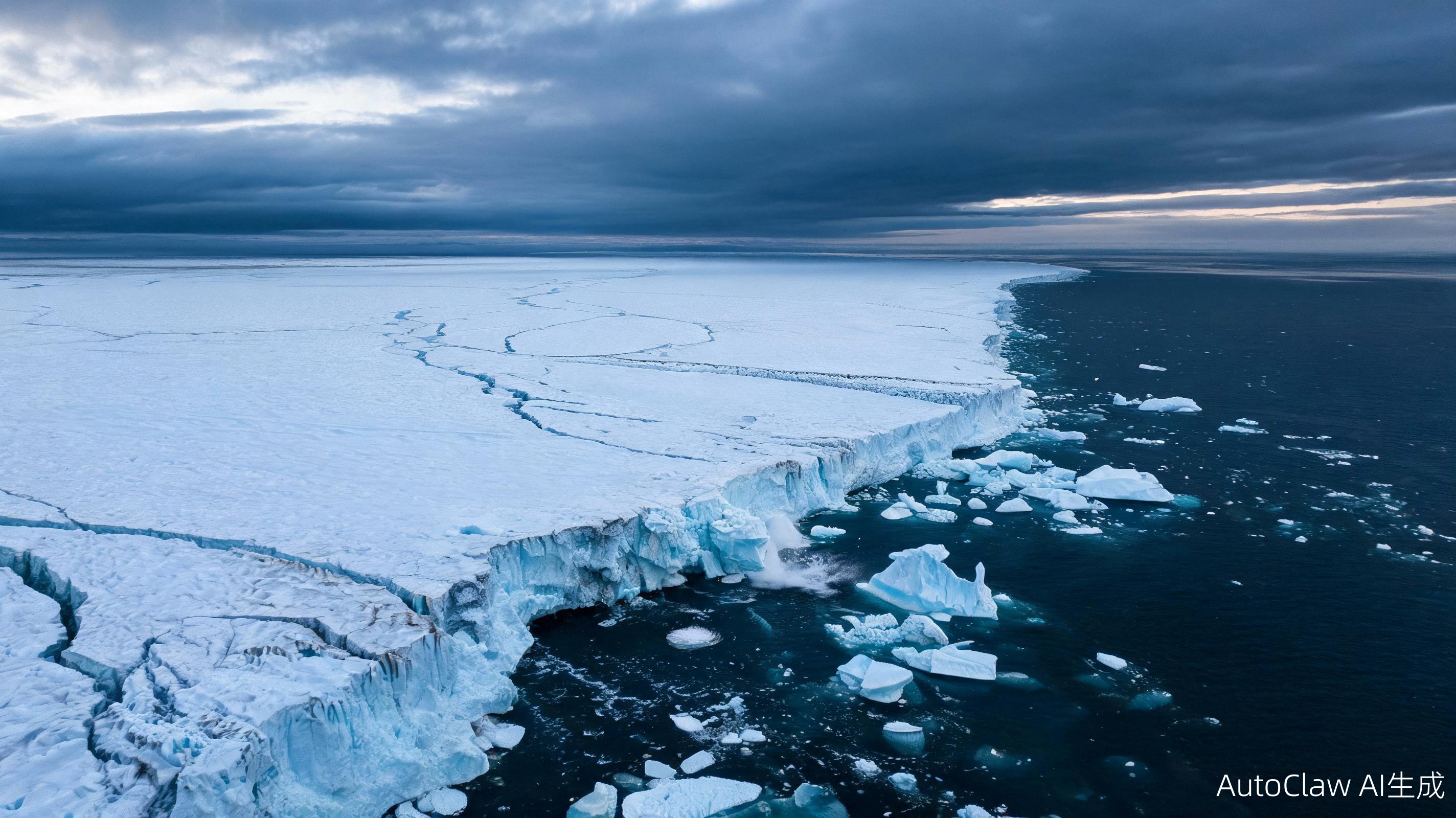
A study reconciling 50 satellite estimates finds the Greenland and Antarctic ice sheets lost 11,309 billion tonnes of ice between 1979 and 2023, lifting sea level by 3.14 centimetres — with fast-flowing glaciers, not surface melt, doing most of the damage
【1】The Greenland and Antarctic ice sheets, which together hold enough frozen fresh water to raise the world's oceans by more than sixty metres, are shedding ice at a pace that grows harder to ignore each year.Yet precisely how much ice, and how fast, has long depended on which satellite record one chose to trust.
【2】Now an international team, coordinated through the Ice Sheet Mass Balance Intercomparison Exercise, has reconciled roughly fifty independent estimates into one authoritative record.By aggregating satellite altimetry, which gauges ice-surface height, with gravimetry, which weighs the ice from orbit, they produced a forty-four-year account rival methods had never agreed upon.
【3】The verdict is stark.Between 1979 and 2023 the two ice sheets shed 11,309 billion tonnes of ice, a figure whose scale—enough to bury Europe beneath more than a metre of water—is difficult to grasp, let alone reverse.
【4】Of that total, the Antarctic Ice Sheet contributed 4,780 billion tonnes, raising global sea level by 13.3 millimetres, with Greenland supplying most of the remainder.Greenland's losses, modest at the outset, have since accelerated so sharply that researchers describe the trend as entering "hyperdrive."
【5】More surprising is what has driven the melt.Fully eighty-four per cent of the loss, the authors calculate, stems not from surface melting but from dynamicalimbalance—the quickening flow of glaciers that dump ice into the sea as icebergs calve from their snouts, a process that, once begun, can feed on itself.
【6】"The ice sheets are melting away fast," one coordinator observed, adding that fast-flowing outlet glaciers, whose margins are bathed in ever-warmer seawater, now discharge far more ice than snowfall can replenish.
【7】For the hundreds of millions who live within a metre of the sea, the message is uncomfortable.The thirty-one millimetres of rise already delivered may sound trivial, but it is cumulative, and every extra tonne lost pushes low-lying coastlines closer to the flooding scientists have long predicted.
【8】The authors are candid about their limits.Because the fifty estimates still diverge in places, the record carries an uncertainty of 565 billion tonnes and cannot alone say whether losses will follow their current trajectory; what it establishes is a single agreed baseline from which the future can be measured.
【9】For a public inclined to treat polar ice as a distant abstraction, the finding is at once humbling and instructive.The ice sheets are not passive scenery but slow-moving reservoirs of change, and knowing how much they have surrendered is the indispensable first step toward deciding how much more we will allow them to lose.
The Greenland and Antarctic ice sheets, which together hold enough frozen fresh water to raise the world's oceans by more than sixty metres, are shedding ice at a pace that grows harder to ignore each year.
主干:The Greenland and Antarctic ice sheets ... are shedding ice at a pace(主语 + are shedding + 宾语 + 状语)
非限制性定语从句:which together hold enough frozen fresh water to raise the world's oceans by more than sixty metres(which 指代 ice sheets)
定语从句:that grows harder to ignore each year(that 修饰 pace)
By aggregating satellite altimetry, which gauges ice-surface height, with gravimetry, which weighs the ice from orbit, they produced a forty-four-year account rival methods had never agreed upon.
主干:they produced a forty-four-year account(主语 + produced + 宾语)
方式状语:By aggregating satellite altimetry ... with gravimetry("通过把……与……汇总")
Between 1979 and 2023 the two ice sheets shed 11,309 billion tonnes of ice, a figure whose scale—enough to bury Europe beneath more than a metre of water—is difficult to grasp, let alone reverse.
主干:the two ice sheets shed 11,309 billion tonnes of ice(主语 + shed + 宾语)
同位语:a figure(解释前面的数字)
whose 定语从句:whose scale ... is difficult to grasp(whose 修饰 figure)
插入的同位语:enough to bury Europe beneath more than a metre of water(解释 scale)
Fully eighty-four per cent of the loss, the authors calculate, stems not from surface melting but from dynamical imbalance—the quickening flow of glaciers that dump ice into the sea as icebergs calve from their snouts, a process that, once begun, can feed on itself.
主干:eighty-four per cent of the loss ... stems not from surface melting but from dynamical imbalance(not ... but ... 结构)
插入语:the authors calculate("作者们估算")
同位语:the quickening flow of glaciers(解释 dynamical imbalance)
定语从句 + 时间状语从句:that dump ice into the sea as icebergs calve from their snouts(that 修饰 glaciers;as 引导时间状语从句)
同位语 + 定语从句 + 省略式状语:a process that, once begun, can feed on itself(once begun = once it is begun)
考点:not ... but ... 并列;插入语;同位语;as 时间状语从句;once + 过去分词
Because the fifty estimates still diverge in places, the record carries an uncertainty of 565 billion tonnes and cannot alone say whether losses will follow their current trajectory; what it establishes is a single agreed baseline from which the future can be measured.
主干:the record carries an uncertainty ... and cannot alone say whether ...(并列谓语)
原因状语从句:Because the fifty estimates still diverge in places("因为……")
宾语从句:whether losses will follow their current trajectory(whether 引导,作 say 的宾语)
主语从句:what it establishes is a single agreed baseline(what 引导主语从句)
定语从句:from which the future can be measured("介词 + which" 修饰 baseline)
思考题:结合第 5 段与第 6 段,为什么"动力失衡"比"表面融化"更令人担忧?"冰山崩解"这一过程为何能"自我强化"(feed on itself)?请用自己的话说明这条机制链。
仿写题:仿照第 9 段 "The ice sheets are not passive scenery but slow-moving reservoirs of change, and knowing how much they have surrendered is the indispensable first step toward deciding how much more we will allow them to lose."("not A but B" 并列结构 + 动名词短语作主语 + 名词化表达)的句式,围绕「节约资源」「保护环境」或「珍惜时间」写一个句子。