It takes 172 routine clinical tests, pooled across more than 104,000 adults, to reveal how fast a body is ageing — and the answer turns out to differ sharply by sex, with two distinct midlife turning points
【1】Ageing is usually imagined as a single, gradual decline that unfolds at roughly the same pace in every person.A sweeping new analysis, however, argues that the body keeps several distinct clocks, and that they tick at very different speeds in men and women.
【2】The work, published on 25 August 2026 in Nature Aging, was led by researchers at the China National Center for Bioinformation and the Chinese Academy of Sciences, with collaborators from several hospitals across the country.Rather than relying on expensive molecular assays, the team analysed routine clinical data from 104,208 adults aged 18 to 98, drawn from three centres and covering 172 commonly measured indicators.
【3】By pooling such measurements across metabolism, immunity, liver and kidney function and tumour markers, the researchers built sex-specific clocks capable of estimating a person's biological age.Each clock performed well within its own sex, but a model trained on men predicted women's ages poorly, and vice versa, hinting that the two sexes age along genuinely different paths.
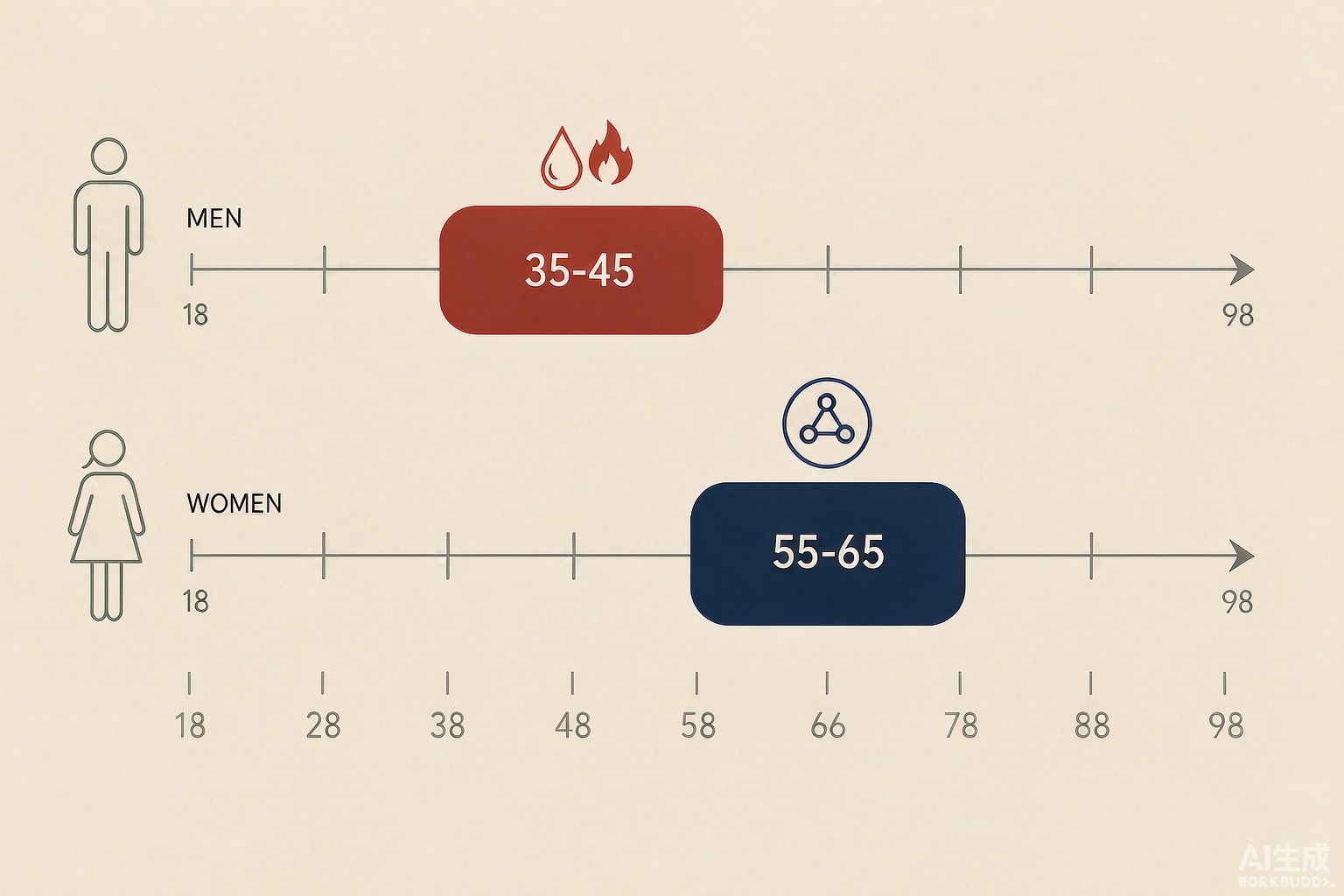
【4】The clearest divergence appeared in middle age, when the two trajectories pulled sharply apart.Men showed a pronounced metabolic transition between the ages of 35 and 45, with body mass index, triglycerides and cholesterol all climbing steeply, a shift the authors describe as a midlife metabolic crisis.
【5】Women experienced their own transition considerably later, between 55 and 65, closely overlapping with menopause.It was marked by sharp rises in follicle-stimulating hormone and luteinising hormone, accompanied by worsening lipid profiles, yet the physiological gap between the sexes gradually narrowed again in later life.
【6】The study did not stop at mere description, for several metabolic factors and tumour-related markers were found to accumulate with age and to track with accelerated biological ageing.When the team exposed vascular endothelial cells to elevated glucose, lipids, uric acid and the markers CEA and HE4, the cells displayed ageing-related changes, implying that these circulating signatures may actively drive ageing rather than merely reflect it.
【7】Crucially, some of that damage looked reversible.Metformin, a common diabetes drug, eased the endothelial ageing caused by high glucose, and simply moving mice from a high-fat diet to a normal one improved several ageing features in the liver.
【8】For the authors, the value of the research lies as much in its practicality as in its scale.Because the clocks rest on tests that hospitals already perform routinely, they could one day let doctors flag accelerated ageing long before disease appears and tailor the moment of intervention to each patient's sex.
【9】The authors are careful to note that the analysis is observational, so it can reveal associations but cannot prove that any single factor causes ageing.Even so, the two turning points it identifies may mark the moments when preventive medicine has the most to gain, and they reframe the question as not whether we age but when each of us begins to.
原文出处:本文根据 Nature Aging 论文《Sex-specific aging clocks from a large-scale human phenome reveal distinct aging transitions and circulating signatures》(Jiaming Li et al.;China National Center for Bioinformation / 中国科学院动物研究所 / 首都医科大学宣武医院等;Nature Aging, published online 25 August 2026, DOI: 10.1038/s43587-026-01180-5)改写整理,供学习使用。
三、长难句分析(三步拆解法)
Rather than relying on expensive molecular assays, the team analysed routine clinical data from 104,208 adults aged 18 to 98, drawn from three centres and covering 172 commonly measured indicators.
主干:the team analysed routine clinical data(主语 + 谓语 + 宾语)
rather than 状语:Rather than relying on expensive molecular assays("与其依赖……,不如……",置于句首表取舍)
后置定语(一):aged 18 to 98(过去分词短语修饰 adults)
后置定语(二):drawn from three centres and covering 172 ... indicators(两个并列的分词短语修饰 data)
考点:rather than 表取舍;过去分词与现在分词并列作后置定语(drawn 表被动、covering 表主动)
Each clock performed well within its own sex, but a model trained on men predicted women's ages poorly, and vice versa, hinting that the two sexes age along genuinely different paths.
主干:Each clock performed well ... but a model ... predicted women's ages poorly(并列句,转折)
后置定语:trained on men(过去分词短语修饰 a model)
插入语:and vice versa("反之亦然",补充说明反向同样失准)
现在分词作结果状语:hinting that the two sexes age along genuinely different paths(对前半句做出推论)
考点:but 连接并列转折;vice versa 的用法;分词短语表伴随/结果;宾语从句 that ...
Men showed a pronounced metabolic transition between the ages of 35 and 45, with body mass index, triglycerides and cholesterol all climbing steeply, a shift the authors describe as a midlife metabolic crisis.
主干:Men showed a pronounced metabolic transition(主语 + 谓语 + 宾语)
时间状语:between the ages of 35 and 45
with 复合结构:with body mass index, triglycerides and cholesterol all climbing steeply("with + 宾语 + 现在分词",表伴随)
同位语:a shift (that/which) the authors describe as a midlife metabolic crisis(省略关系代词的同位语从句)
考点:with 复合结构作状语;现在分词表主动、进行;同位语从句中 describe A as B 结构
It was marked by sharp rises in follicle-stimulating hormone and luteinising hormone, accompanied by worsening lipid profiles, yet the physiological gap between the sexes gradually narrowed again in later life.
主干:It was marked by sharp rises ... yet the physiological gap ... narrowed again(被动 + 转折并列)
被动的施动者:by sharp rises in follicle-stimulating hormone and luteinising hormone
过去分词作伴随状语:accompanied by worsening lipid profiles(伴随情况)
考点:be marked by"以……为标志";accompanied by 表伴随;yet 作并列连词表转折
When the team exposed vascular endothelial cells to elevated glucose, lipids, uric acid and the markers CEA and HE4, the cells displayed ageing-related changes, implying that these circulating signatures may actively drive ageing rather than merely reflect it.
时间状语从句:When the team exposed vascular endothelial cells to elevated glucose, ...(expose A to B 结构)
仿写题:仿照第 5 段 "It was marked by sharp rises in ..., accompanied by ..., yet the ... gap ... gradually narrowed again in later life."(be marked by + accompanied by 伴随状语 + yet 转折)的句式,围绕「两个群体的差异随年龄/时间变化」写一个句子。