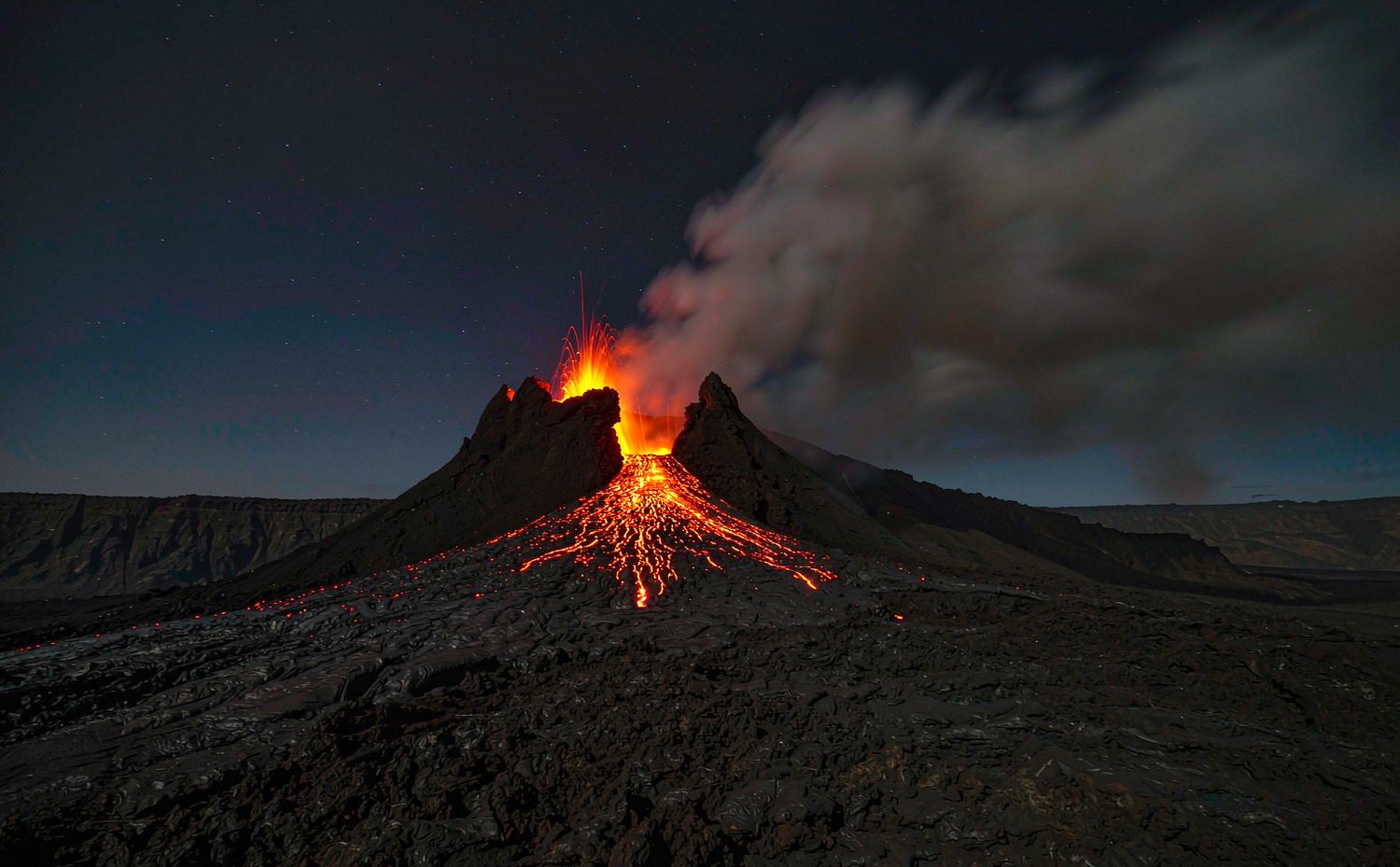
A single seismometer, watching a restless volcano from eight kilometres away, has sensed a signal so faint that it is measured in nanometres per second cubed — and flagged almost every eruption for more than a decade
【1】Volcanoes seldom announce their intentions in a language that everyone can readily read, and forecasting an eruption remains one of the hardest problems in the earth sciences.For decades volcanologists have relied on dense networks of instruments and on the careful judgement of observers, yet a simple, automatic warning that works in real time has stayed stubbornly out of reach.
【2】A team from the Paris Institute of Earth Physics and the German Research Centre for Geosciences has now proposed a strikingly different answer, built not on complexity but on restraint.Their system, described in Nature Communications in December 2025, listens for a signal so faint that it is measured in nanometres per second cubed.
【3】The method is named jerk, a nod to the quantity it tracks, which physicists define as the rate at which acceleration changes rather than the acceleration itself.A jerk, in this physical sense, is the sudden sideways lurch of the ground that occurs when rock fractures and magma forces open a fresh path towards the surface.
【4】To test the idea, the researchers installed a single very wide-band seismometer in a temperature-stable tunnel that hosts it, roughly eight kilometres from Piton de la Fournaise, one of the most active volcanoes on Earth.The station sits on the French island of Réunion and has been running since April 2014.
【5】The data are processed to strip out the dominant signals of the Earth's tides, after which the system computes horizontal jerk and compares it with a fixed threshold of 0.1 nanometres per second cubed, twice the average background noise.A directional filter aimed towards the volcano then decides whether the disturbance is meaningful or merely noise.
【6】When the threshold is crossed, the system flags an alert, emailing and telephoning the scientist on duty at the observatory without any human intervention.Over twelve years, whenever the station was operational, such an alert was triggered for every one of the twenty-five eruptions that followed.
【7】In 92 per cent of cases the warning proved actionable, arriving anywhere between a few minutes and more than eight hours before the eruption began.Two summit eruptions sent magma to the surface so directly that the signal arrived almost simultaneously with the tremor, leaving no useful lead time, while four false alarms turned out to mark intrusions that stalled underground.
【8】The authors suggest that this lurch is a blend of ground tilt and horizontal acceleration caused by the fracturing of rock during the final stage of migration.The team now plans to test the method on Mount Etna in Italy and Mount Merapi in Indonesia.
【9】For poorly instrumented explosive volcanoes, where a single sensor may be the only realistic option, such a tool could buy the hours needed to evacuate.The researchers are careful to note that the system cannot say how much magma lies below, or when the next eruption will come; it simply recognises the moment when the rock gives way.
原文出处:本文根据 Nature Communications 论文《Jerk signal recorded during the January 18, 2026, eruption at Piton de la Fournaise》(F. Beauducel, G. Roult, V. Ferrazzini, A. Peltier, P. Jousset, P. Boissier, N. Villeneuve;Institut de Physique du Globe de Paris / Helmholtz Centre for Geosciences (GFZ) Potsdam;Nature Communications, December 2025)改写整理,供学习使用。
三、长难句分析(三步拆解法)
The data are processed to strip out the dominant signals of the Earth's tides, after which the system computes horizontal jerk and compares it with a fixed threshold of 0.1 nanometres per second cubed, twice the average background noise.
主干:The data are processed(被动语态:主语 + 谓语)
目的状语:to strip out the dominant signals of the Earth's tides(to do 表目的,说明"处理数据"是为了什么)
非限制性定语从句:after which the system computes horizontal jerk and compares it with ...("after + which"引导,which 指代前面整件事)
同位语(补充说明):twice the average background noise(用倍数结构解释 0.1 纳米/立方秒的量级)
When the threshold is crossed, the system flags an alert, emailing and telephoning the scientist on duty at the observatory without any human intervention.
时间状语从句:When the threshold is crossed("当……被越过时")
主干:the system flags an alert(主语 + 谓语 + 宾语)
现在分词作伴随状语:emailing and telephoning the scientist on duty at the observatory(说明报警的具体方式)
介词短语作状语:without any human intervention(强调全过程自动化)
考点:when 引导时间状语从句;分词短语表伴随动作;on duty 作后置定语修饰 the scientist
Two summit eruptions sent magma to the surface so directly that the signal arrived almost simultaneously with the tremor, leaving no useful lead time, while four false alarms turned out to mark intrusions that stalled underground.
主干:Two summit eruptions sent magma to the surface(主语 + 谓语 + 宾语 + 补足语)
结果状语从句:so directly that the signal arrived almost simultaneously with the tremor(so ... that ... 结构)
现在分词作结果状语:leaving no useful lead time(对前半句的后果做补充)
并列转折:while four false alarms turned out to mark intrusions(while 表对比,引出另一面的情况)
For poorly instrumented explosive volcanoes, where a single sensor may be the only realistic option, such a tool could buy the hours needed to evacuate.
To test the idea, the researchers installed a single very wide-band seismometer in a temperature-stable tunnel that hosts it, roughly eight kilometres from Piton de la Fournaise, one of the most active volcanoes on Earth.
目的状语:To test the idea("为验证这一构想")
主干:the researchers installed a single very wide-band seismometer(主语 + 谓语 + 宾语)
定语从句:that hosts it(修饰 tunnel,it 指代 seismometer)
同位语:roughly eight kilometres from Piton de la Fournaise, one of the most active volcanoes on Earth(补充说明台站与火山的位置关系)
仿写题:仿照第 7 段 "Two ... did sth so directly that ..., leaving no useful lead time, while four ... turned out to mark ... that stalled underground."(so ... that 结果状语 + leaving 分词结果 + while 对比并列)的句式,围绕「两个案例结果截然不同」写一个句子。