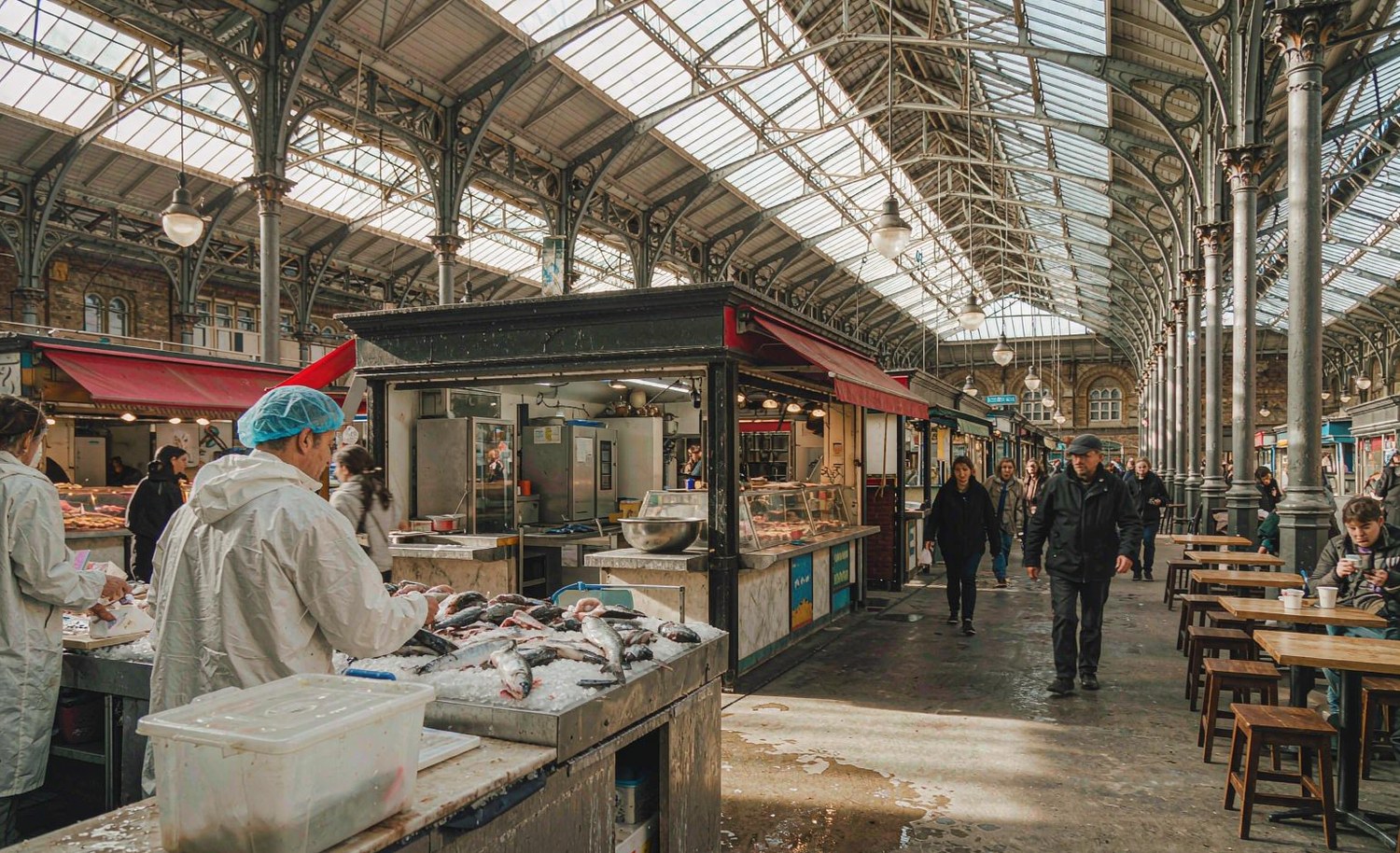
Two English towns spent millions restoring their indoor markets. One counted 50,000 visitors in six months; the other is forecasting a loss of £338,000 — and the difference is not the building
【1】The new market in Oldham opened in March; by the end of September more than 50,000 people had walked through it, which its council read as proof the indoor market can still be saved.In Derby, a hall restored for £35 million is forecasting a loss of £338,000, and critics say the city has bought a food court with a roof.
【2】Both buildings had answered the same brief.For two centuries the covered market was the room in which a town met itself — a fishmonger beside a barber, a stall selling a pound of nails, a bench where nobody had to buy anything — and hundreds have closed since the 1990s, leaving councils to sell their revival as regeneration.
【3】Oldham's numbers look like proof the formula works.Footfall is up 15 per cent, traders report weekly sales up by roughly a fifth, and a fishmonger from the old site says he sees more customers than ever.The hall is also a cut-through between a car park and a shopping centre, which the barber credits for the traffic past his chair.
【4】Derby tells the other half.Its Grade II listed hall reopened in May 2025 to a crowd of 30,000 and still draws 15,000 visits a week, yet the deficit is blamed on rents from food and drink traders landing below budget and on pitches left empty by departing tenants.Opposition councillors say it simply feels empty, and want the old wet-fish market back.
【5】The difference lies less in the masonry than in what fills it.Both halls drifted from fish, fabric and hardware towards coffee, small plates and events — dog shows, beer festivals, farmers' markets — because that is what brings a crowd through the door, and the shift quietly changes who can afford a pitch.
【6】Visitors and income are different measurements, and councils publish the first because it is easier to count.An event can fill a hall on a Saturday and sell almost nothing, while the dull weekday lunch trade is what pays the rent.Where rent is a share of turnover, a building can be busy and still lose money — precisely the gap Derby's review has run into.
【7】Something quieter is lost too: a stall has always been the cheapest door into business — a few hundred pounds, no lease, no shopfront — and it is where a town's newcomers, teenagers and second careers have begun.Raise the fit-out, the rent and the polish of the place, and the people who most needed that door are priced out of it first.
【8】There is a reason councils keep reaching for footfall.What makes a market valuable — a bench you can sit on without buying, a trader who knows your name, a place where a sixteen-year-old can test a business idea — is nearly impossible to put in a spreadsheet, so the countable number wins the meeting and the uncountable one quietly drops out of the plans.
【9】A market is not revived by the crowd it draws on opening day but by the door it keeps open afterwards.The test is whether someone with £400 and no track record can still get a pitch a year later — and that is a question no footfall counter can answer.
原文出处:本文据 The Oldham Times《More than 50,000 people visited Oldham's new market in first six months》(2026 年 9 月,引述 Oldham 议会增长事务主管 James Kington 及市场摊贩 Mark Crossley、Patrick、Ross McGivern、Kelly Bentley)与 BBC News《Derby's Market Hall forecasting six-figure loss》(2026 年 9 月,引述 Derby 市议会领袖 Nadine Peatfield 及保守党议员 John Wright、Steve Hassall)公开报道改写整理,供学习使用。
三、长难句分析(三步拆解法)
For two centuries the covered market was the room in which a town met itself — a fishmonger beside a barber, a stall selling a pound of nails, a bench where nobody had to buy anything — and hundreds have closed since the 1990s, leaving councils to sell their revival as regeneration.
主干:the covered market was the room ... and hundreds have closed ...(两个并列分句,前句讲"是什么",后句讲"后来怎样")
定语从句:in which a town met itself(介词 + which 引导,先行词是 the room;meet oneself 在此是"社区自我碰面"的比喻)
破折号插入:— a fishmonger beside a barber, a stall selling a pound of nails, a bench where nobody had to buy anything —(三项列举,把抽象的"房间"具体化为三个画面;selling 是现在分词作定语,where 从句修饰 bench)
结果状语:leaving councils to sell their revival as regeneration(现在分词表自然结果;leave sb to do sth"使某人不得不做")
考点:介词 + which;现在分词作定语与状语;破折号插入语;leave sb to do;sell sth as sth
Its Grade II listed hall reopened in May 2025 to a crowd of 30,000 and still draws 15,000 visits a week, yet the deficit is blamed on rents from food and drink traders landing below budget and on pitches left empty by departing tenants.
主干:Its hall reopened ... and still draws ..., yet the deficit is blamed on ...(前两个谓语讲"热闹",yet 一转,讲"亏损")
be blamed on 的两个宾语:on rents ... and on pitches ...(介词宾语并列,注意第二个 on 不能省,否则歧义)
两个后置修饰:landing below budget(现在分词修饰 rents,表"实际落在预算之下");left empty by departing tenants(过去分词修饰 pitches,表被动"被离去的租户留下空置")
Both halls drifted from fish, fabric and hardware towards coffee, small plates and events — dog shows, beer festivals, farmers' markets — because that is what brings a crowd through the door, and the shift quietly changes who can afford a pitch.
主干:Both halls drifted from A towards B ... and the shift quietly changes who can afford a pitch(and 连接两个分句,前句讲变化,后句讲后果)
原因状语从句:because that is what brings a crowd through the door(that 指前面的 coffee、small plates 与 events;what 引导表语从句)
破折号插入:— dog shows, beer festivals, farmers' markets —(三个例子具体说明 events,均用复数名词并列,节奏紧凑)
宾语从句:who can afford a pitch(疑问词引导,作 changes 的宾语;afford 后省略了 to rent)
考点:drift from A towards B;what 引导表语从句;破折号插入举例;who 引导宾语从句;the shift 回指前文
What makes a market valuable — a bench you can sit on without buying, a trader who knows your name, a place where a sixteen-year-old can test a business idea — is nearly impossible to put into a spreadsheet, so the countable number wins the meeting and the uncountable one quietly drops out of the plans.
主干:What makes a market valuable ... is nearly impossible to put into a spreadsheet(主语从句作主语,谓语是 is;nearly impossible 后接不定式)
主语从句内部:What makes a market valuable(what = the thing that,整体作主语,不要误读成疑问句)
破折号插入:三项列举,分别带定语从句(you can sit on 省略了 which;who knows your name;where a sixteen-year-old can test a business idea)
结果分句:so the countable number wins ... and the uncountable one quietly drops out(one 替代 number;countable / uncountable 构成对照,是本段的关键词对)
A market is not revived by the crowd it draws on opening day but by the door it keeps open afterwards, and the test is whether someone with £400 and no track record can still get a pitch a year later.
主干:A market is not revived by A but by B(not ... but ... 的对照,被动语态;两个 by 引出"被什么救活")
两个省略关系词的定语从句:the crowd (that) it draws on opening day;the door (that) it keeps open afterwards(draw a crowd 吸引人群;keep sth open 保持开着)
表语从句:whether someone ... can still get a pitch a year later(whether 引导,作 the test is 的表语;a year later 是时间状语)
修辞:crowd / door 押头韵,opening day / afterwards 构成"一时"与"此后"的时间对照——结尾句因此带判断句的分量
考点:not ... but ... 的平行;被动语态中 by 的状语;省略关系代词的定语从句;whether 引导表语从句
仿写题:仿照结尾句 "A market is not revived by the crowd it draws on opening day but by the door it keeps open afterwards."(先用 not ... but ... 把"一时"与"此后"两个标准对置,两个 by 后各带一个省略关系词的定语从句),就"一所学校的价值"或"一个公园的价值"写一句你自己的判断句,再用一句话给出可检验的判据。